Flyhweel V3
Tags: journal and thinkPersonhours: 6
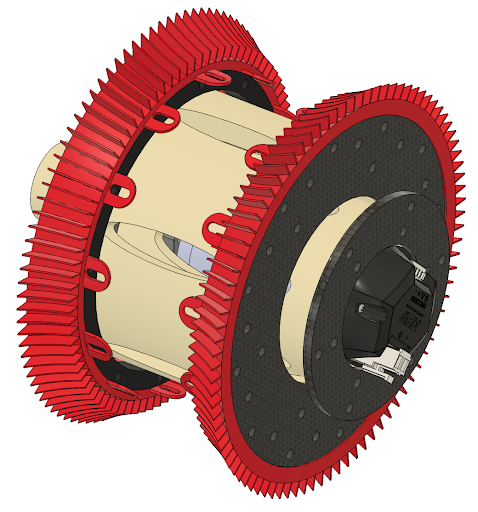
We’ve made some crucial updates to our flywheel design, resulting in a much-needed boost in power. This iteration, named Rimfire, builds upon lessons learned from our previous versions and focuses on improving rigidity, airflow, and traction to create a more efficient and powerful launcher.
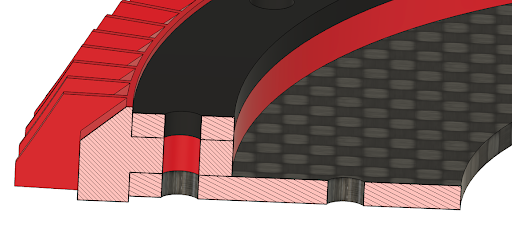
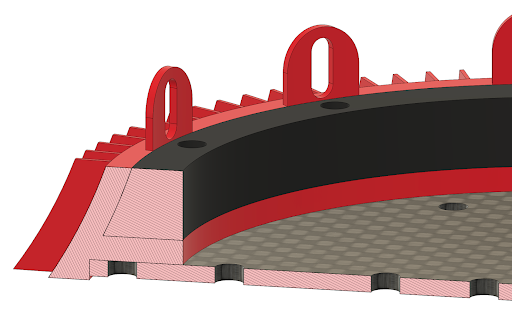
One of the biggest overhauls was to the disks of the flywheel themselves. The T-tires were made larger and more substantial, which required a bigger PA-CF sandwiching ring and the machining of new mounting holes on the carbon fiber plates. The flaps were also extended in both length and height to increase the amount of surface contact and friction between the flywheel and the artifact. The flaps profile of the TPU flaps were re-designed to more closely match the profile of the Artifacts. To accommodate the new T-tires, we also increased the thickness of the sandwich ring. While this was necessary to fit the larger tires, it had the added benefits of improving the rigidity of the solid TPU structure beneath the flaps. The result was a flywheel that feels sturdier and transmits power more efficiently during launch. The old version is on the top, and the new version is on the bottom.
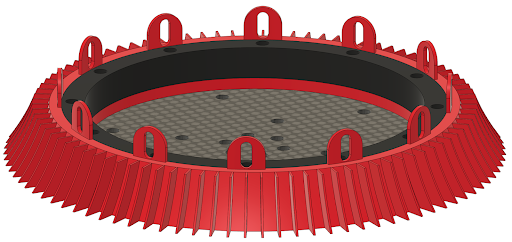
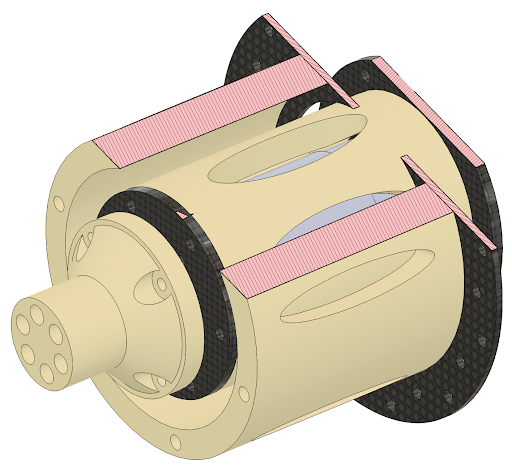
We also made significant improvements to the motor mount and external shell. The new motor mount now features oval-shaped ventilation holes: a shape chosen to maintain structural strength while maximizing open area for airflow. These holes help air circulate around the motor to prevent overheating. We also designed a nylon outer shell to connect both sides of the flywheel. It includes the same ventilation pattern for cooling and adds valuable structural support. In future versions, we may experiment with chamfered or directional openings to better control airflow, potentially channeling it along the flywheel’s spin to further improve cooling. Interestingly, the added weight from this outer shell also increases the system’s rotational inertia, contributing to higher launch momentum.