
Custom Compliant Silicone Wheels V1
Tags: journalPersonhours: 12
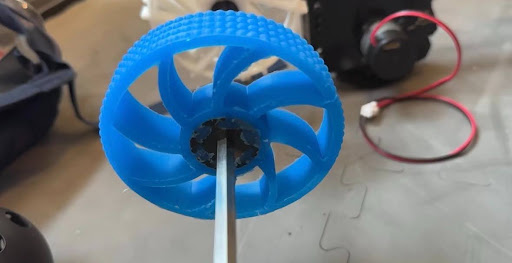
When we made our Ri2D bot, the chassis had a completely static intake with non compliant wheels. From our testing, we realized that we would need to have a large amount of compliance in at least a part of the intake in order to manipulate both Pollen and Nectar. For this reason, we purchased compliant wheels from SWYFT robotics, and once we realized how soft they were, we decided to attempt making our own custom silicone compliant wheels. Going down this rabbit hole would allow for increased customizability, the opportunity to learn a new skill, and would be much faster than printing wheels out of TPU.
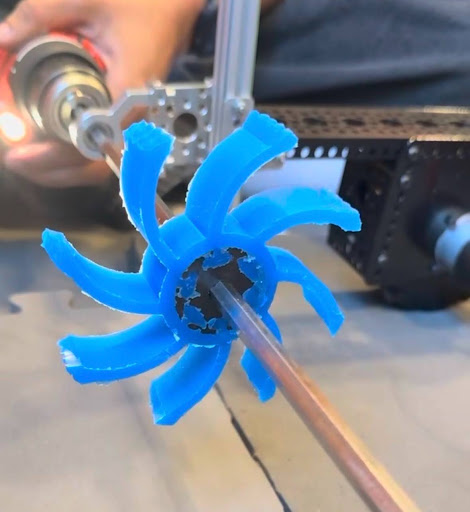
For our first attempt we decided to make a simple 100mm outer diameter (OD) wheel with 8 curved stems that protrude from the center of the wheel. We chose to use 8 stems to ensure a balance between compliance and stiffness. Too many stems would defeat the purpose of a compliant wheel, and if eight proved to be too many, we could simply cut some of the stems off. We settled on a curved profile for the stems, instead of a straight one, because we thought it should be more conducive to intaking when spinning with the curve. Additionally, we decided to add nubs to the outer edge of the silicon wheel in order to increase its grip on the game elements.
The compliant wheels are essentially a two part design since they require a solid core at the center. We’re familiar with this type of core design as our custom TPU wheels required a similar structure. This core as well as removable spacers are placed inside of our custom mold in order to form the shape of the wheel. We’re attempting to design our mold to be very easy to use as well as reusable in order to simplify and speed up the casting process for the future.
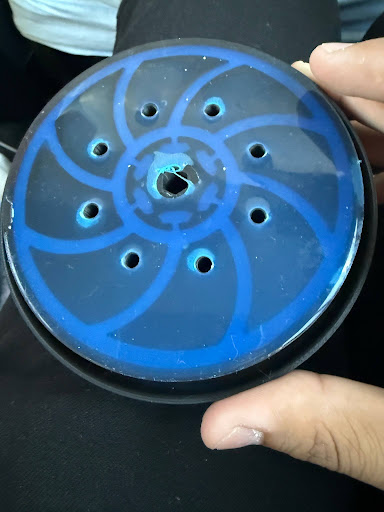
When tested against SWYFT compliant wheels, we noticed that the two worked very similarly. However, ours was still slightly less flexible due to being about 8mm thicker. Further testing of our custom wheels revolved around endurance in the most extreme circumstances. While we’re quite familiar with Ninjaflex TPU intakes, this was our first time working with custom silicone wheels. We wanted to ensure that our material and design choices could stand up to routine FTC use cases and, more importantly, beyond.
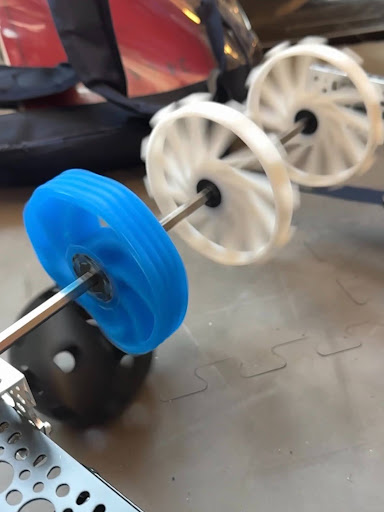
Our first major test involved holding a PLA nectar replica still while running the intake wheels on it for about five minutes. We did this under speeds higher than normal for FTC use cases and kept constant, high pressure on the wheel. The compliant wheel was completely fine, and in fact, the heat from the friction slightly deformed the 3d printed replica nectar.
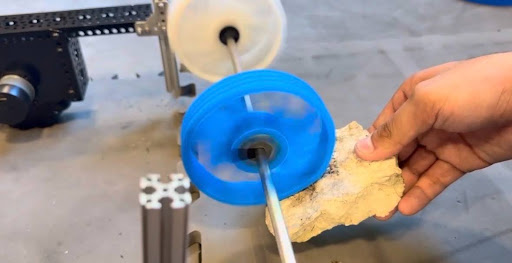
Ever had to intake a rock with your FTC robot? Well, we basically did with our second test! This time, instead of using a nectar, we used a rock. We wanted to see if a rough texture might start to tear the wheel, but we saw no such results after 4 minutes of continuously running the intake.
Our final test involved stretching the wheel apart until failure. This required two people pulling at opposite ends, and the wheel only tore at a weak connection point between a stem and the encasing diameter. Overall, these results increased our confidence in these custom wheels and helped us become more informed on how they work.
After we had ripped the complaint wheel, we decided to just cut out the entirety of the surrounding ring so that only the core and stems would remain. This profile ended up being more compliant and successful at manipulating both elements at a single height than the original wheel design. For this reason, we decided to transition over to this start design rather than a full wheel for the future. Additionally, we will lengthen the stems by about 5 millimeters and transition over to using a stronger material for the core instead of PLA.
Stay updated with our wheel’s journey as we continue to post about it!